

Credit: Unsplash
President Biden invokes the Defense Production Act to strengthen American supply chains.
In a strategic move to fortify American supply chains and boost domestic manufacturing, President Joe Biden is invoking the 1950 Defense Production Act, a Cold War-era law that empowers the executive branch to compel U.S. companies to support projects in the interest of national security. The decision, announced by the White House on Monday, is aimed at addressing supply chain issues contributing to higher inflation and enhancing the resilience of critical sectors.
The Defense Production Act, previously utilized during the COVID-19 pandemic, will now be employed to invest in the “domestic manufacturing of essential medicines.” The Department of Health and Human Services has earmarked $35 million for investments in the domestic production of key starting materials to mitigate drug shortages, as outlined in the press release.
To spearhead these efforts, President Biden will convene the first meeting of the President’s Supply Chain Resilience Council, which will announce additional measures related to the production and shipment of goods. The council, co-chaired by Lael Brainard, Director of the White House National Economic Council, and Jake Sullivan, White House National Security Adviser, comprises heads of cabinet departments, the administration’s Council of Economic Advisers, the U.S. Director of National Intelligence, the Office of Management and Budget, and other agencies.
The Defense Production Act was enacted during Covid under Trump.
Biden just enacted it to make more heat pumps.
I think he did this to use it for other purposes too…the heat pump thing is a ploy. pic.twitter.com/nvURd10cWb— The Coffee Drinker (@TCDMS99) November 22, 2023
Addressing concerns about the economy, the White House acknowledges that while the U.S. economy appears robust on paper, consumers are experiencing challenges. The administration emphasizes that robust supply chains are fundamental to a strong economy, citing their role in lowering prices for goods, food, and equipment.
The move comes amid polling indicating that only 39% of voters approve of President Biden’s handling of jobs and the economy. With the economy being a top concern for Americans, the administration is taking steps to enhance supply chain resilience and address economic challenges.
In addition to domestic production measures, the administration pledges to strengthen global supply chains by developing early warning systems with allies and partners to detect and respond to disruptions. This includes initiatives to improve weather, water, and climate observing capabilities and data-sharing to produce global climate information and minimize impacts on infrastructure, water, health, and food security.
-
 The Trump administration has signaled a willingness to pursue renewed negotiations with Iran through Qatari mediators, even as military...
-
A federal appeals court has rejected an emergency request from the U.S. Department of Justice (DOJ) to prevent California...
-
The United States is entering the final days of its 2026 midterm election campaign, with political advertising reaching unprecedented...
-
With less than two weeks remaining before the November 3, 2026, midterm elections, political campaigns across the United States...
-
The 2026 Nobel Prize announcements celebrated remarkable achievements in science and literature, recognizing researchers who helped solve a longstanding...
-
The U.S. Treasury Department launched a major financial enforcement action on October 1 targeting the A7 Network, a Russia-linked...
-
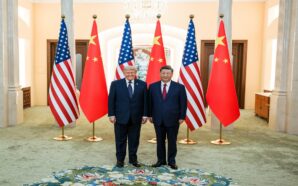
U.S. President Donald Trump hosted Chinese President Xi Jinping in Washington from September 23 to 25 for a three-day...
-
Wildland firefighters across the United States are facing another demanding fire season, with federal agencies operating at Preparedness Level...
-
A quarter of a century has now passed since September 11, 2001. On September 11, 2026, Americans marked the...
-
The H-1B visa program is back at the center of the U.S. immigration and employment debate. A presidential proclamation...
-
The United States and Venezuela have entered a sweeping energy agreement that could reshape the relationship between the two...
-
The United States has temporarily stepped back from imposing new 50% tariffs on around $20 billion worth of Canadian...