

Credit: Shutterstock
On April 1, the U.S. Supreme Court began hearing arguments in one of the year’s most high-stakes legal battles: the Trump administration’s challenge to birthright citizenship. This case could fundamentally alter the landscape of immigration law and citizenship in the United States. The outcome has the potential to impact millions of children born in the U.S. and stir nationwide debates on the interpretation of the Constitution.
The Argument
At the heart of the case is the Trump administration’s push to end birthright citizenship, a long-standing legal principle based on the 14th Amendment. The administration argues that citizenship should not be automatically granted to children born on U.S. soil if their parents are not legal residents or citizens. This stance directly challenges the traditional interpretation of the 14th Amendment, which has long guaranteed birthright citizenship, regardless of the parents’ immigration status.
The case has sparked intense legal and political debates, as both sides argue their interpretations of the Constitution. Proponents of the administration’s position believe that citizenship should be granted based on the legal status of the parents, while opponents argue that the 14th Amendment’s language, particularly its reference to “jurisdiction,” should protect birthright citizenship as an unchangeable right.
Constitutional Stakes
The legal stakes of the case are monumental. Legal scholars are divided on the interpretation of the 14th Amendment. Some argue that the amendment’s “jurisdiction” clause, which refers to people within the U.S. under its jurisdiction, supports the administration’s efforts to limit birthright citizenship. They argue that this could lead to a more restrictive policy, ensuring that only children born to parents who are legal residents or citizens are granted automatic citizenship.
On the other hand, opponents of the move point to 125 years of legal precedent, particularly the landmark case Wong Kim Ark (1898), which upheld the principle of birthright citizenship. They argue that overturning this longstanding interpretation would have far-reaching consequences, not just for immigration law but for the very principles of equal protection and justice guaranteed by the Constitution.
The issue, at its core, revolves around how the Constitution should be interpreted and whether long-standing legal precedents should be maintained or revisited. It is a constitutional showdown that could reshape U.S. immigration policy for generations to come.
National Protest

Credit: Shutterstock
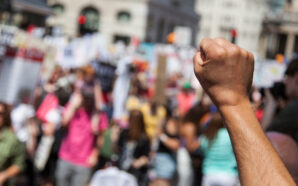
As the Supreme Court hearings progressed, protests erupted across the country, particularly in major cities like Los Angeles and Chicago. These demonstrations reflected the intense public interest in the case, with activists, immigrants, and concerned citizens rallying against what they see as an unconstitutional attempt to strip away rights guaranteed by the 14th Amendment.
The protests have not just been about birthright citizenship—they have become a rallying point for broader political and social issues surrounding immigration, human rights, and racial justice. With the 2026 political season on the horizon, the hearings and their outcome have taken on even greater significance, setting the stage for further national debates on immigration policy.
Looking Ahead
The Supreme Court’s decision on birthright citizenship could have lasting effects on the nation’s immigration policies. While the outcome of the case is still uncertain, it is clear that the arguments and protests surrounding it will continue to fuel discussions about the meaning of citizenship and the rights of immigrant families in America.
As the country watches closely, the 2026 political season will likely see these debates intensify, with candidates and citizens alike grappling with the ramifications of this potentially historic ruling.

-
 Todd Lyons, the acting director of U.S. Immigration and Customs Enforcement (ICE), announced that he will step down at...
 -
On Sunday night, April 13, President Donald Trump ignited a major online controversy after posting an AI-generated image on...
-
The Springs Fire near Moreno Valley, California, which began on April 4, was brought under control quickly thanks to...
-
Over the weekend of March 28–29, large-scale “No Kings” protests took place across the United States, drawing millions of...
-
A powerful storm system swept across the Eastern United States beginning March 15 and continuing into March 16, bringing...
-
Ahead of Donald Trump’s second inauguration as President of the United States, Canadian experts expressed strong concerns about how...
-
Credit: Shutterstock In a dramatic and decisive operation, Mexican Special Forces have dealt a historic blow to organized crime,...
-
Credit: Shutterstock Former President Barack Obama proved Sunday night that his reflexes — and his love for the game...
-
Credit: Shutterstock While the Super Bowl delivered its usual edge-of-your-seat action on the field, millions of fans made a...
-
Credit: Shutterstock The U.S. Department of Justice on Friday unveiled its most extensive disclosure yet in the Jeffrey Epstein...
-
Credit: Shutterstock In a dramatic reset aimed at cooling tensions, Border Czar Tom Homan has ordered Border Patrol leadership...
-
Credit: Shutterstock Former President Donald Trump has once again ignited global controversy—this time by reviving his push for U.S....