

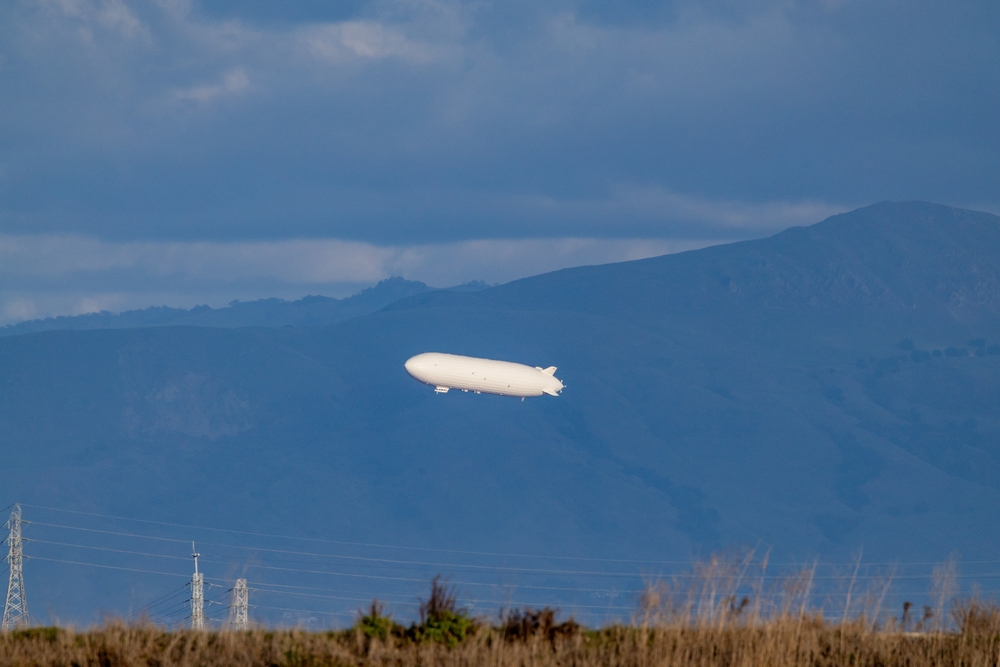
Bay Area residents who recently glanced up over the Golden Gate Bridge were treated to an unexpected visitor: a gleaming, silver airship so large it made the familiar sightseeing blimps look toy-sized. No, it wasn’t a movie stunt or a marketing gimmick — it was the Pathfinder 1, the world’s largest aircraft, quietly beginning a new chapter for lighter-than-air aviation.
Built by LTA Research, the Pathfinder 1 stretches an astonishing 406.5 feet long and 66 feet wide, making it significantly larger than traditional blimps like the 246-foot Goodyear icons that shaped public imagination for decades. But unlike those blimps, Pathfinder 1 is a rigid airship — a modern reimagining of a classic design once overshadowed by early-20th-century disasters and hydrogen-fueled mishaps.
Today, helium and high-tech engineering are driving a safer, cleaner, and perhaps even visionary comeback for airships.
Why is Pathfinder 1 Flying Over the Bay Area?
The answer is simple: testing. LTA Research recently expanded its authorized flight zone, allowing Pathfinder 1 to move beyond Moffett Federal Airfield, where it completed tethered and initial free-flight trials. Now, the mammoth aircraft is navigating longer routes over San Francisco as part of its proof-of-concept program.
These flights help the company evaluate the airship’s performance, maneuverability, and systems integration — all essential steps before Pathfinder 1 moves into real-world missions.
What's being called the world's largest aircraft, the 124.5-meter-long Pathfinder 1, took flight this morning over San Francisco's Golden Gate Bridge. The massive airship, created by LTA Research, aims to kickstart an era of climate-friendly air travel that can potentially carry… pic.twitter.com/vFwrb2XPMd
— ABC7 News (@abc7newsbayarea) October 28, 2025
Not Your Grandparents’ Airship
Airships have long battled a reputation for being slow, fragile, and unsafe. But experts say that modern technology is changing the story.
“Airships offer some intriguing possibilities for aviation,” notes J. Gordon Leishman, professor of aeronautical engineering at Embry-Riddle Aeronautical University. Advances such as carbon-fiber structures, electric propulsion, and fly-by-wire controls have transformed what was once a niche curiosity into a potential tool for sustainable transportation.
And unlike helicopters or airplanes, airships enjoy one huge advantage: they float. Buoyancy provides free lift — a fact LTA Research CEO Brett Crozier highlights as a key reason the company sees a future in lighter-than-air design.
new bay area commute just dropped
(Sergey’s LTA research airship leaving the Moffett Field nest) pic.twitter.com/KMafWzERnk
— Ian Brooke (@k2pilot) October 28, 2025
A Future Built on Lift, Quiet Flight, and Access
Beyond spectacle, LTA Research envisions airships becoming workhorses that can reach places far beyond the limits of existing infrastructure. Their potential roles include:
- Delivering disaster-relief supplies to regions with damaged roads or no runway access
- Transporting cargo with significantly reduced carbon emissions
- Carrying passengers over scenic regions at low altitude and quiet speed
- Supporting humanitarian missions in remote communities
Airships can travel at speeds comparable to trucks, yet use far less fuel. And they don’t need runways at all — just open space and favorable weather.
There are challenges, of course. Helium is costly and in limited supply, and airships remain more sensitive to weather than conventional aircraft. Whether commercial demand will grow enough to support widespread airship routes remains an open question. But as history has shown, public interest in airships tends to rise and fall in cycles. For now, curiosity is soaring once again.
A Skyborne Hint at Aviation’s Next Chapter
Whether Pathfinder 1 becomes the first in a new fleet of sustainable sky cruisers or simply the spark for renewed imagination, its presence over San Francisco marks a moment of possibility. And as residents look upward at the serene giant drifting across the skyline, one thing is clear: the future of flight may be quieter, cleaner, and more buoyant than we ever expected.

-
 Credit: Shutterstock In a dramatic and decisive operation, Mexican Special Forces have dealt a historic blow to organized crime,...
 -
Credit: Shutterstock Former President Barack Obama proved Sunday night that his reflexes — and his love for the game...
-
Credit: Shutterstock While the Super Bowl delivered its usual edge-of-your-seat action on the field, millions of fans made a...
-
Credit: Shutterstock The U.S. Department of Justice on Friday unveiled its most extensive disclosure yet in the Jeffrey Epstein...
-
Credit: Shutterstock In a dramatic reset aimed at cooling tensions, Border Czar Tom Homan has ordered Border Patrol leadership...
-
Credit: Shutterstock Former President Donald Trump has once again ignited global controversy—this time by reviving his push for U.S....
-
Credit: Shutterstock Political tensions across the Americas surged this weekend after former U.S. President Donald Trump issued stark warnings...
-
Credit: Shutterstock Minnesota Governor Tim Walz responded Sunday to mounting concerns over a major fraud scandal after a viral...
-
Credit: Shutterstock The Department of Justice has reversed course and restored previously removed images from the Jeffrey Epstein document...
-
Credit: Shutterstock The world of film, television, and political activism is reeling from the sudden and devastating news of...
-
Credit: Shutterstock JPMorgan Chase CEO Jamie Dimon delivered an unusually direct rebuttal this week after Trump Media & Technology...
-
Credit: Shutterstock A shocking new 115-page report has peeled back the curtain on life inside the FBI under Director...